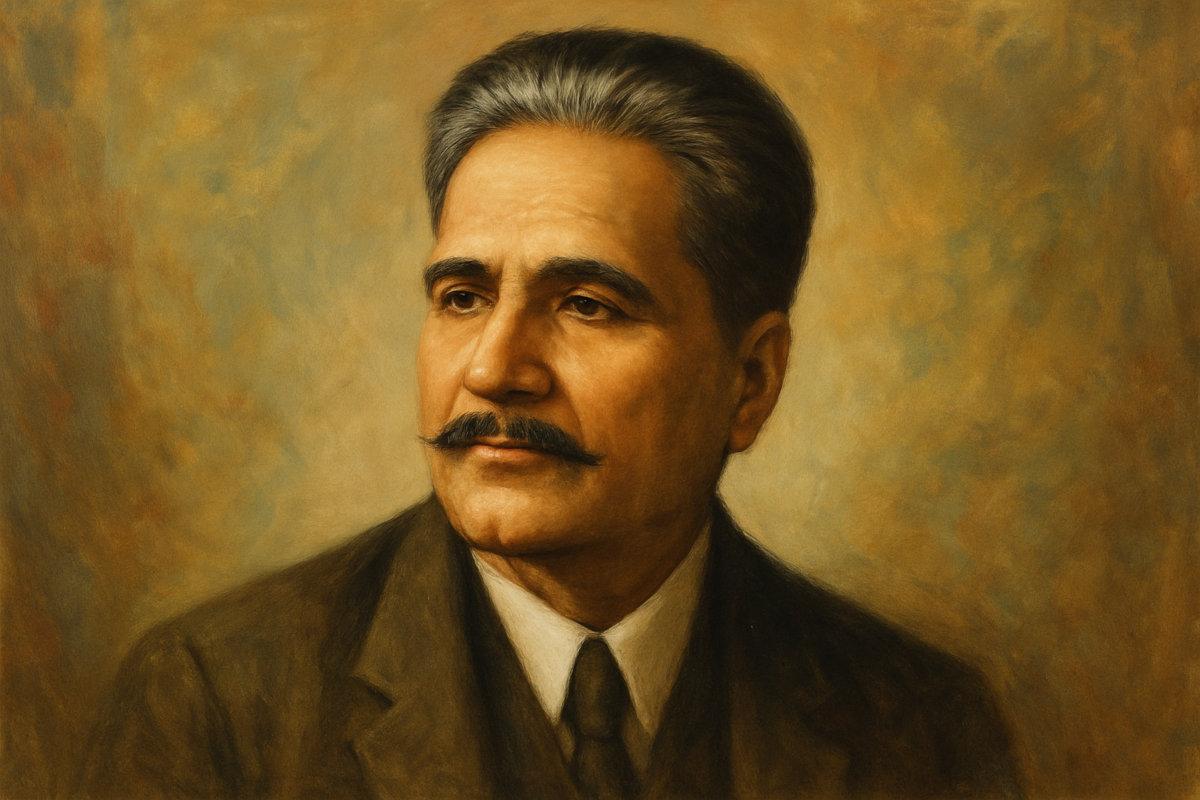
Allama Iqbal Biography: Life, Poetry, and Philosophical Legacy
Introduction
Allama Muhammad Iqbal (1877–1938), popularly recognized as the “Poet of the East” and “Mufakkir-e-Pakistan” (Thinker of Pakistan), was a philosopher, poet, and visionary. Through his Persian and Urdu poetry, he inspired millions and stirred up the spirit of self-realization, renaissance, and solidarity among the Muslims of the subcontinent. Iqbal’s intellectual contributions provided the ideological basis for the establishment of Pakistan.
Early Life of Allama Iqbal
Iqbal was born on 9 November 1877 in Sialkot, Punjab (now in Pakistan), to a Kashmiri family. His father, Sheikh Noor Muhammad, was a deeply religious Muslim, while his mother, Imam Bibi, was famous for her liberality and piety. Iqbal was deeply interested in poetry, philosophy, and Islamic thought from the early days of his life.
Education and Intellectual Growth
Iqbal got his initial education in Sialkot, and then proceeded to Government College, Lahore, where he aced in philosophy and literature. He traveled overseas for further studies, securing a degree in philosophy from Cambridge University, and subsequently a PhD in philosophy from Munich University. He also studied law at Lincoln’s Inn, London.
This encounter with Western philosophy, coupled with his profound understanding of Islamic heritage, influenced his philosophy of selfhood (Khudi) and Islamic values revival.
Allama Iqbal’s Philosophy and Teachings
Iqbal’s philosophy centered on spiritual awakening, self-discovery, and empowerment of the Muslim world. His major ideas are:
Khudi (Selfhood) – Faith in self-awareness and inner power as the key to success.
Iqbal’s vision for a dynamic Islam – A plea to Muslims to reinterpret Islamic doctrine in the contemporary age.
Pan-Islamism – Stress on solidarity among Muslims worldwide.
Vision for an independent homeland – His Allahabad Address (1930) became the stepping stone for Pakistan.
Poetry and Major Works of Iqbal
Allama Iqbal composed widely in Persian and Urdu, integrating philosophy, spirituality, and inspiration. His most renowned works are:
Bang-e-Dra (The Call of the Marching Bell) – Urdu poetry collection invoking self-respect and nationalism.
Asrar-e-Khudi (Secrets of the Self) – A Persian treatise giving priority to selfhood.
Rumuz-i-Bekhudi (The Secrets of Selflessness) – Companion to Asrar-e-Khudi.
Zabur-e-Ajam – Persian poetry book.
Payam-e-Mashriq (Message of the East) – A reply to Goethe’s West-östlicher Divan.
His patriotic song “Sare Jahan se Achha Hindustan Hamara” is still one of the most revered poems in the Indian subcontinent.
Role in Pakistan Movement
Although Iqbal did not live to witness the establishment of Pakistan, his dream contributed immensely to its emergence. In his Allahabad Address (1930), he described the concept of an independent state of Muslims in Northwest India. This conception later influenced Quaid-e-Azam Muhammad Ali Jinnah and the Pakistan Movement.
Death and Legacy
Allama Iqbal died on 21 April 1938 in Lahore. His tomb stands side by side with the Badshahi Mosque in Lahore and is a place of national pride and reverence. He is also remembered as a national poet, a philosopher, and the spiritual patriarch of Pakistan.
Iqbal’s legacy continues through his poetry, philosophy, and his appeal for intellectual and spiritual renaissance among Muslims.
The biography of Allama Iqbal is a journey through the life of a poet, philosopher, and visionary whose words reshaped the destiny of a nation. His teachings of Khudi, self-respect, and unity continue to inspire people worldwide, making him one of the most influential thinkers of the 20th century.